
Boat Mildew Removal Tampa
Boat mildew removal in Tampa that removes mildew stains from vinyl seats, compartments, and interior surfaces.
FUN FACTS!: Your stomach gets a new lining every few days so it doesn’t digest itself.
Boat Mildew Removal Tampa
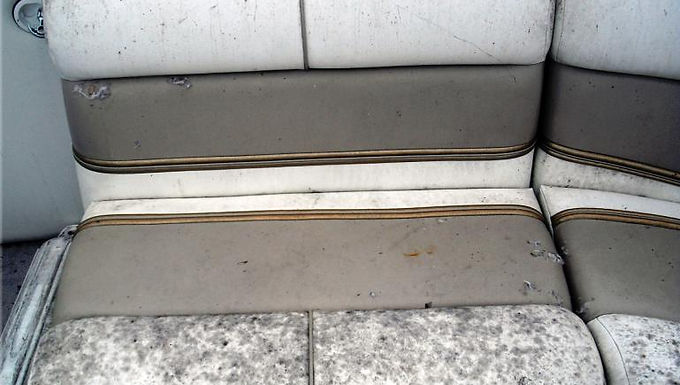
That musty smell when you open up the boat after a few weeks at the dock — that's not just stale air. That's mildew. And by the time you can smell it, it's already growing on your vinyl seats, inside compartments, along stitching seams, and potentially deep inside the foam underneath your cushions.
Mildew is one of the most common and most misunderstood problems on boats in this area. We deal with it constantly as part of our boat detailing service in Tampa, and the owners who call us almost always say the same thing: "I had no idea it was this bad."
It Lives Inside the Foam
This is the part most boat owners don't know, and it changes how you think about the problem entirely.
Mildew isn't just on the surface of your vinyl seats. The spores that cause visible staining on the outside are also growing inside the cushion foam underneath. Vinyl seating on most boats is stitched around a foam core. When moisture gets trapped between the vinyl shell and the foam — through humidity, rain, condensation, or simply being on the water — it creates a warm, damp, dark environment directly inside the cushion. That's exactly where mildew thrives.
A marine upholstery professional in Miami put it plainly: you can clean the vinyl surface and kill what's visible, but unless the foam is addressed, it comes back. You might get one season out of a surface-level cleaning. Maybe two. But the root system is still alive inside the cushion, and it will push back to the surface as soon as conditions are right.
In Tampa, conditions are right almost every day of the year.
Why Tampa Is a Mildew Factory
Mildew needs three things to grow: moisture, warmth, and something organic to feed on. Tampa delivers all three in excess.
Humidity in this area is consistently high — often 70% or above during boating season. That moisture saturates the air inside every compartment, storage area, and enclosed space on your boat. Even boats that aren't in the water absorb ambient moisture through the air, and boats on the water are surrounded by it.
Temperature stays warm enough year-round to sustain mildew growth. During summer months, the heat inside a covered or closed-up boat can create conditions where mildew grows daily. Enclosed compartments, seat bases, and the space underneath Bimini tops become incubators — dark, warm, damp, and stagnant.
The organic material that mildew feeds on is everywhere. Dust, skin cells, body oils, sunscreen residue, food particles, pollen — all of it settles onto surfaces and provides exactly what the fungus needs to establish colonies. Modern marine vinyl comes factory-treated with antimicrobial additives that help resist mildew, but those treatments wear down over time, especially when boat owners unknowingly scrub them away with harsh cleaners.
The Bleach Trap
This is where well-intentioned boat owners make the problem worse.
Bleach kills mildew on contact. It also destroys your seats. Every vinyl manufacturer advises against using bleach on marine vinyl because it strips the essential oils that keep the material flexible and durable. It breaks down the stitching thread that holds cushions together. It can discolor nearby carpet and canvas.
A boat owner who hits mildew stains with bleach gets a clean-looking seat today and a deteriorating one six months from now. The vinyl loses its suppleness, starts cracking, and becomes more porous — which actually makes it easier for mildew to take hold next time. Bleach is a last resort before replacement, not a maintenance solution.
Marine-safe mildew removers are formulated to break down the fungal staining without destroying the vinyl's protective properties or degrading the stitching. They work differently than bleach — dissolving the organic material rather than burning it off — and they preserve the life of the seat while eliminating the visible contamination.
What Airborne Spores Mean for Your Whole Boat
Mildew reproduces through microscopic spores that float freely through the air. Once a colony establishes on one surface — a seat cushion, a compartment wall, the underside of a canvas top — those spores travel throughout the boat's interior.
They land on other vinyl surfaces, inside lockers, on carpet, on rope and canvas. Wherever moisture and organic residue exist, a new colony can start. This is why boat owners who notice one small patch of mildew often find it spreading to multiple areas within weeks. The boat's enclosed spaces act like an incubation chamber — circulating spores from established colonies to fresh surfaces constantly.
Removing mildew early, before it spreads beyond the initial site, saves significant time and cost. Once it gets into multiple surfaces across the interior, the scope of remediation expands dramatically.
How Professional Mildew Removal Works
The process starts with inspecting the entire boat interior — not just the obviously affected seats. Mildew often hides in seams, underneath cushions, inside compartment lids, along canvas edges, and in areas with poor airflow that owners rarely check.
Affected surfaces are treated with marine-safe cleaning solutions formulated to break down mildew staining and kill active growth without damaging vinyl, canvas, or stitching. The cleaners need contact time to penetrate the stain and dissolve the fungal material beneath the surface — this isn't a spray-and-wipe process.
After treatment, surfaces are thoroughly wiped and dried. Drying is critical. Mildew removal that leaves residual moisture behind is just resetting the clock. The treated areas need to be completely dry before the boat is closed up or covered.
For boats where mildew has penetrated into cushion foam, surface cleaning alone won't provide a lasting result. In those cases, treating or replacing the foam is the only way to stop the cycle from restarting. We'll tell you honestly when surface treatment is sufficient and when the problem has gone deeper.
Stopping It From Coming Back
Mildew prevention on a boat is an ongoing effort, not a one-time fix. Ventilation is the single most effective tool — air movement reduces moisture and disrupts the stagnant conditions mildew needs. When leaving the boat for more than a day or two, open every drawer, locker, and compartment. Prop cushions up so air circulates underneath. Leave ports cracked when weather allows.
Dry vinyl seats after every trip. Wipe seams and creases where moisture hides. Remove damp gear from compartments immediately. Check interior surfaces regularly — catching mildew early when it's one small spot is a completely different job than dealing with it after it's spread across every seat and compartment.
If you'd like to explore additional services designed to keep your vessel clean and protected, you can visit our main detailing page.
Mildew on a Tampa boat isn't a matter of if — it's when. The humidity, heat, and enclosed spaces guarantee it. Professional removal eliminates what's visible, addresses what's growing underneath, and gives you a clean starting point to keep it under control. The longer it sits, the deeper it goes and the more it costs. Handle it early.