
Exterior Boat Detailing Tampa
Exterior boat detailing in Tampa that removes salt, oxidation, and marine grime while restoring shine and protecting fiberglass surfaces.
FUN FACTS!: A cockroach can live several weeks without its head.
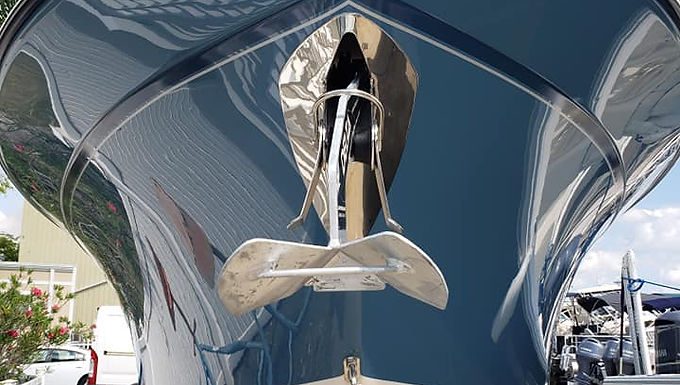
Exterior Boat Detailing Tampa
There's a difference between a clean boat and a detailed boat, and that difference is what separates a vessel that's maintained from one that's slowly losing value at the dock.
Cleaning removes what's sitting on the surface — salt, dirt, grime. Detailing goes deeper. It addresses what's happening to the surface itself — the oxidation forming in the gelcoat, the micro-scratches dulling the hull's reflectivity, the staining that's worked into the pores of the fiberglass, the corrosion developing on hardware. Exterior boat detailing is restoration work. It takes surfaces that have been degraded by Tampa Bay's environment and brings them back to a condition that cleaning alone can't achieve. As part of our boat detailing service in Tampa, exterior detailing compounds, polishes, and protects every surface on the outside of your vessel.
Gelcoat Is Finite — And Tampa Uses It Up Faster
This is the most important thing any boat owner in this market needs to understand: gelcoat doesn't regenerate. The smooth, glossy layer on the outside of your fiberglass hull was sprayed into a mold during manufacturing. It's a single application, typically measured in mils — thousandths of an inch. It's thinnest at the bow, corners, and curves where the manufacturing process naturally produces less material. Once it's gone, it's gone. The fiberglass underneath isn't designed to be an exterior surface.
Every time gelcoat oxidizes and someone compounds it to restore the shine, a thin layer of gelcoat is removed along with the oxidation. That's how compounding works — abrasive particles in the compound cut away the degraded surface to reveal fresh material underneath. The result looks great. But the gelcoat is now thinner than it was before. Do this aggressively enough or frequently enough without proper protection between sessions, and you eventually sand through to fiberglass.
Tampa's UV index is among the highest in the continental United States. Boats here receive more cumulative ultraviolet radiation per year than vessels in virtually any other major boating market. That radiation is what drives oxidation — UV energy breaks the molecular chains in the gelcoat resin, causing it to release chalky particles at the surface. The more UV exposure, the faster oxidation develops, and the sooner the gelcoat needs correction.
This creates a cycle that either works for you or against you. If you detail regularly with the least aggressive approach necessary and protect the surface afterward, you remove minimal material, maintain gelcoat thickness, and keep the boat looking right. If you neglect the surface until it's heavily oxidized, the restoration requires more aggressive compounding that removes more material. Do that repeatedly over the life of the boat, and you accelerate toward the point where the gelcoat can no longer be restored — only repainted or re-gelcoated.
Re-gelcoating a boat runs $15,000 or more. Professional marine repainting with a system like Awlgrip can cost $25,000 to $40,000 depending on the size of the vessel. Annual exterior detailing that prevents the oxidation from ever reaching that stage costs a fraction of either option.
What Each Stage of Oxidation Looks Like
Gelcoat oxidation progresses through recognizable stages, and knowing which stage your boat is in determines what the detailing process needs to accomplish.
Light oxidation appears as a slight loss of gloss. The hull still looks decent from a distance, but up close the surface has lost the deep, wet shine it had when new. If you run your hand across the gelcoat and it feels slightly rough or chalky, that's the oxidized surface layer you're feeling. At this stage, a one-step cleaner-wax or light polish is usually sufficient to restore the finish without removing significant material.
Moderate oxidation is visible without touching the surface. The gelcoat looks dull, flat, and powdery. Color appears faded — whites look chalky gray, colored hulls lose saturation. At this stage, compounding is required to cut through the oxidized layer before polishing can restore the shine. This is a multi-step process that builds from aggressive correction to fine polishing, each step refining the surface the previous step exposed.
Heavy oxidation means the gelcoat has degraded significantly. The surface feels rough, stains have penetrated deep into the pores, and the chalky layer is thick enough that you can see residue on your hand after touching it. Restoration at this stage may require wet sanding before compounding, followed by multiple polishing stages. It's recoverable in most cases — as long as enough gelcoat remains — but it's a 40-plus hour job on a moderately sized vessel, and the boat has lost material that can never be replaced.
Every boat in Tampa is somewhere on this progression. The question is whether you catch it early and maintain it, or let it advance until the only options are expensive.
The Protection Step Determines How Long the Detail Lasts
Compounding and polishing restore the surface. Protection is what keeps it restored. Without a wax, sealant, or ceramic coating applied after correction, the freshly exposed gelcoat begins oxidizing again immediately — and in Tampa's UV environment, "immediately" means measurably within weeks.
Marine wax provides a sacrificial barrier between UV radiation and the gelcoat surface. The wax absorbs the UV energy instead of the gelcoat, slowing the oxidation process. Polymer sealants offer longer-lasting protection with higher resistance to salt and chemical exposure. Ceramic coatings provide the most durable barrier, lasting years with proper maintenance and creating a hydrophobic surface that resists contamination bonding.
The choice of protection depends on how the boat is stored, how frequently it's used, and how much maintenance the owner wants to perform between professional services. A boat stored outdoors on a lift in full Tampa sun needs more aggressive protection than one kept under a covered slip. A vessel used every weekend accumulates more salt exposure between details than one that goes out monthly.
Professional exterior detailing doesn't just restore the surface — it matches the protection to the boat's specific use pattern and exposure level so the results last as long as possible before the next service.
Hardware, Rails, and Everything That Isn't Gelcoat
Gelcoat gets the most attention because it covers the most surface area, but every other exterior component is also degrading under Tampa Bay conditions.
Stainless steel rails and hardware develop tea staining — the brown discoloration that appears when chloride ions from salt exposure penetrate the passive oxide layer that gives stainless its corrosion resistance. Polishing stainless during detailing removes the staining and rebuilds the oxide layer, restoring both appearance and protection.
Aluminum components corrode through galvanic interaction with salt deposits, especially where dissimilar metals are in contact. Cleaning and treating aluminum surfaces prevents the pitting that eventually becomes structural.
Windshield glass and acrylic panels accumulate mineral deposits that bond progressively harder in heat. Non-skid deck surfaces trap contamination in their textured patterns. Rub rails collect dock grime and transfer marks. Every element of the boat's exterior needs attention during a proper detail — not just the hull.
If you'd like to explore additional services designed to restore and protect your vessel, you can visit our main detailing page.
A boat in Tampa Bay is losing gelcoat every day it sits in the sun unprotected. Exterior detailing restores what's been lost, protects what remains, and keeps the boat out of the $15,000 re-gelcoat conversation for as long as possible. That's not cosmetic maintenance. That's preserving the value of the asset.